
The Fumed Silica Green Transition: A Case Study
How Plasma Technology Could Transform Industrial Energy Consumption, Supply Chains and Manufacturing Economics
Introduction
A “case study” implies an analysis of something that has already happened. However, this article examines an ongoing process involving disruptive silicon technology, the challenges of bringing fumed silica to market, potential resistance and interest from established players, and opportunities for new market entrants.
HPQ Silicon and PyroGenesis from Montreal, Canada have developed over ten years a plasma processing method to make fumed silica with considerably less energy and without the toxic byproducts produced by flame hydrolysis invented in 1942 by the German chemist Harry Kloepfer. Fig 1 compares the methods, and reduction in energy use by the plasma processing method is staggering.
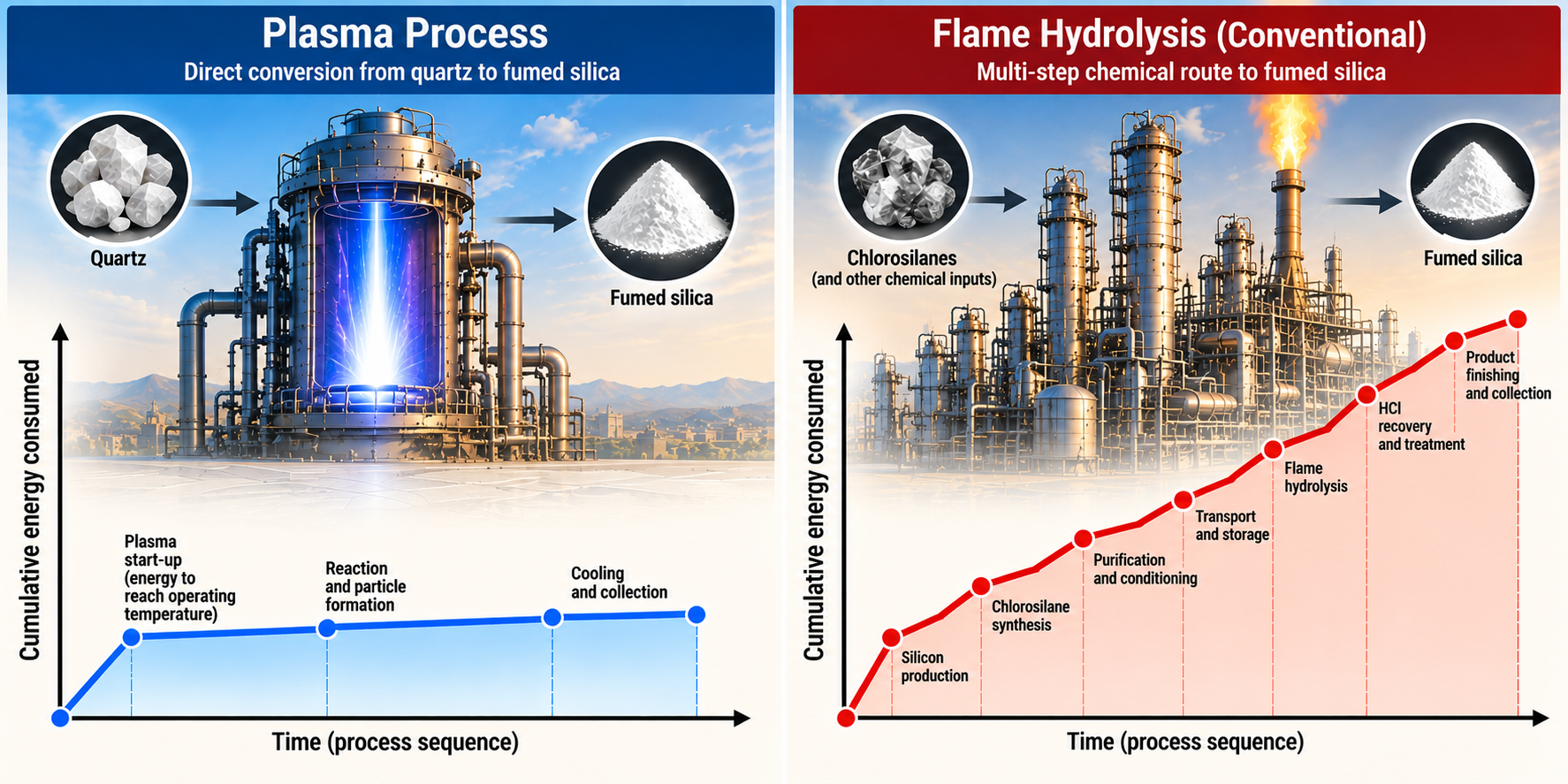
According to HPQ Silicon's published energy estimates, conventional fumed silica production requires 100,000–120,000 kWh per metric tonne, compared with 8,000–12,000 kWh for the proposed plasma process, representing potential energy savings of up to 92%.
The reader might be surprised that the innovation is from a relatively obscure part of Canada, and not east Asia. Whilst it’s true that East Asia is ahead in manufacturing, their success often overshadows that Europe and North America frequently develop disruptive technologies that become a part of the East Asian supply chain. The fumed silica market worth about USD 2.66 billions is dominated by German companies that manufacture 60 percent of global supply mostly outsourced to Chinese factories, followed by China 30 percent, and the United States around 10 percent. Extraordinary claims, such as the dramatic reduction in energy consumption, require extraordinary evidence; so I will explain the science behind the plasma processing of fumed silica that can be accessible to a non-specialist audience.
The Fumed Silica Plasma Reactor
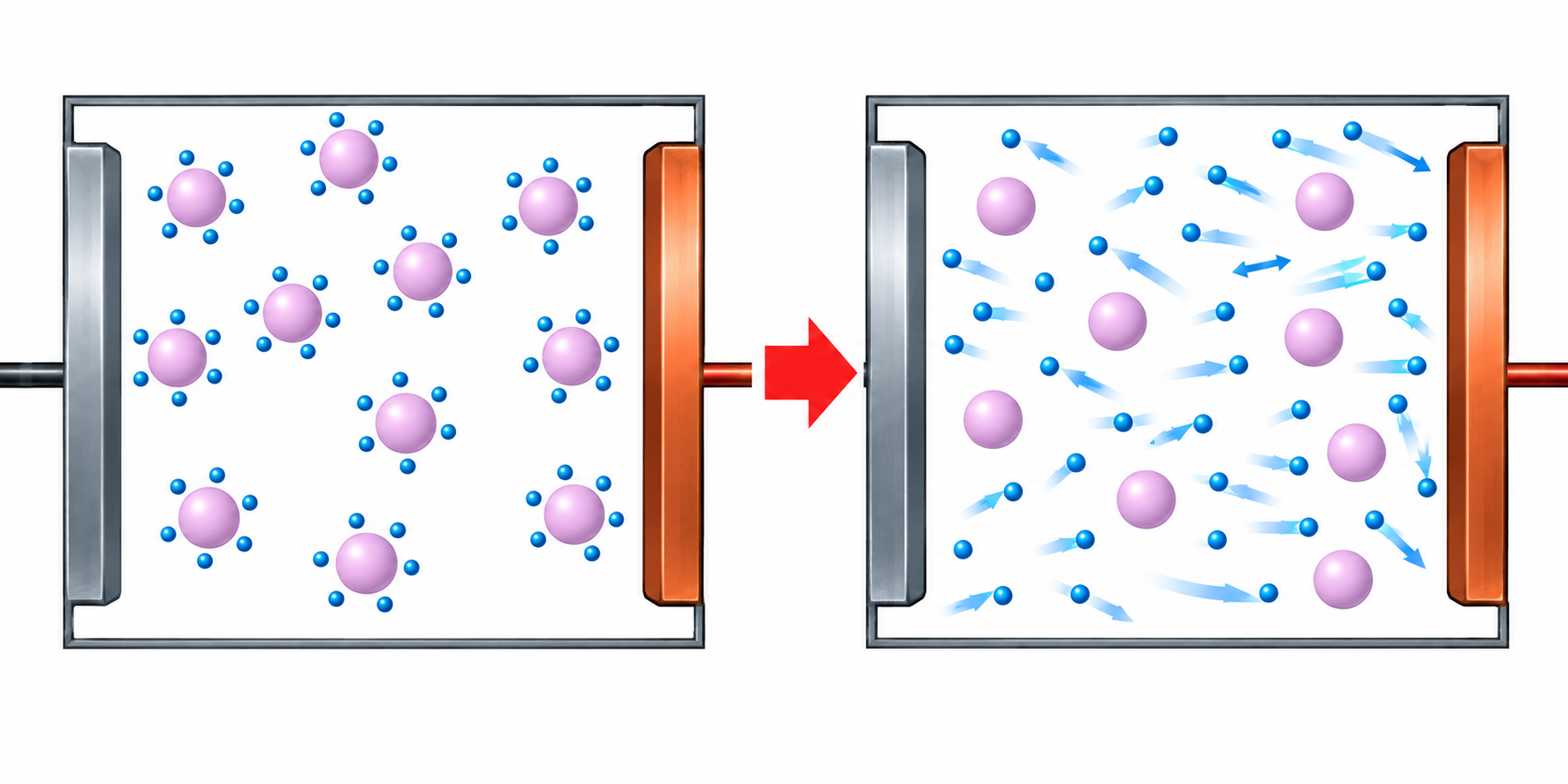
The fumed silica reactor resembles an antiquated Victorian-era contraption with its many pipes, belying its sophistication, which took around 10 years to fine-tune. There is a chamber where electrodes form a strong electric field to ionize a noble gas, as shown in Fig. 2, where the strong electric field liberates electrons. This mechanism is similar to lightning; in essence, we have controlled lightning in a machine. The electrons move at very high speeds, and collisions and radiation heat the plasma to temperatures that can reach 10,000 °C. Noteworthy is that plasma torches typically operate in the 200 kW to 500 kW range which is considerably more powerful than the phased plasma rifle in the 40-watt range requested by the Terminator in the 1984 movie.
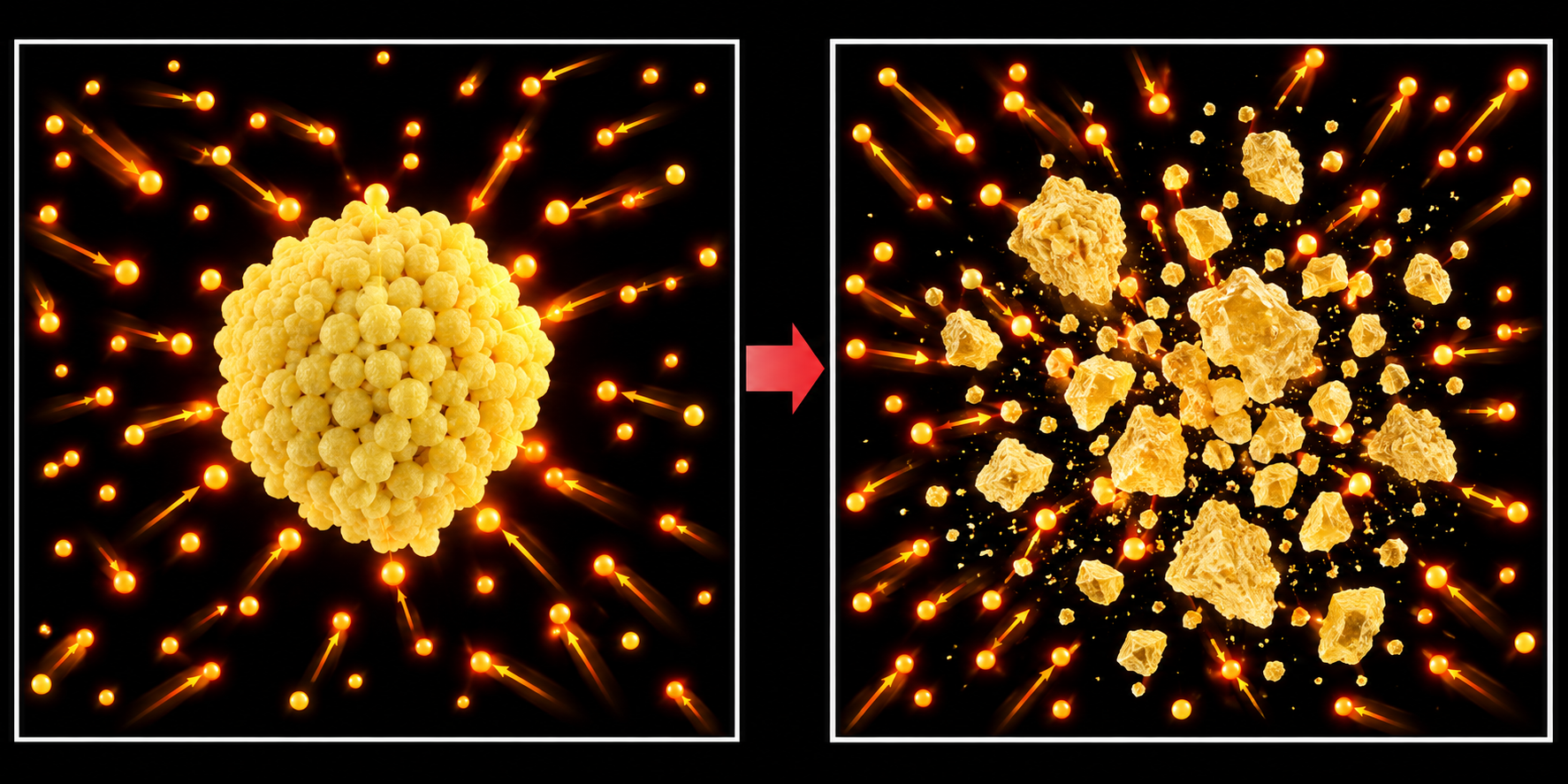
The silicon dioxide powder is then placed inside the plasma chamber, where it begins to vaporize rapidly due to collisions with electrons and radiative heating, as shown in Fig. 3.
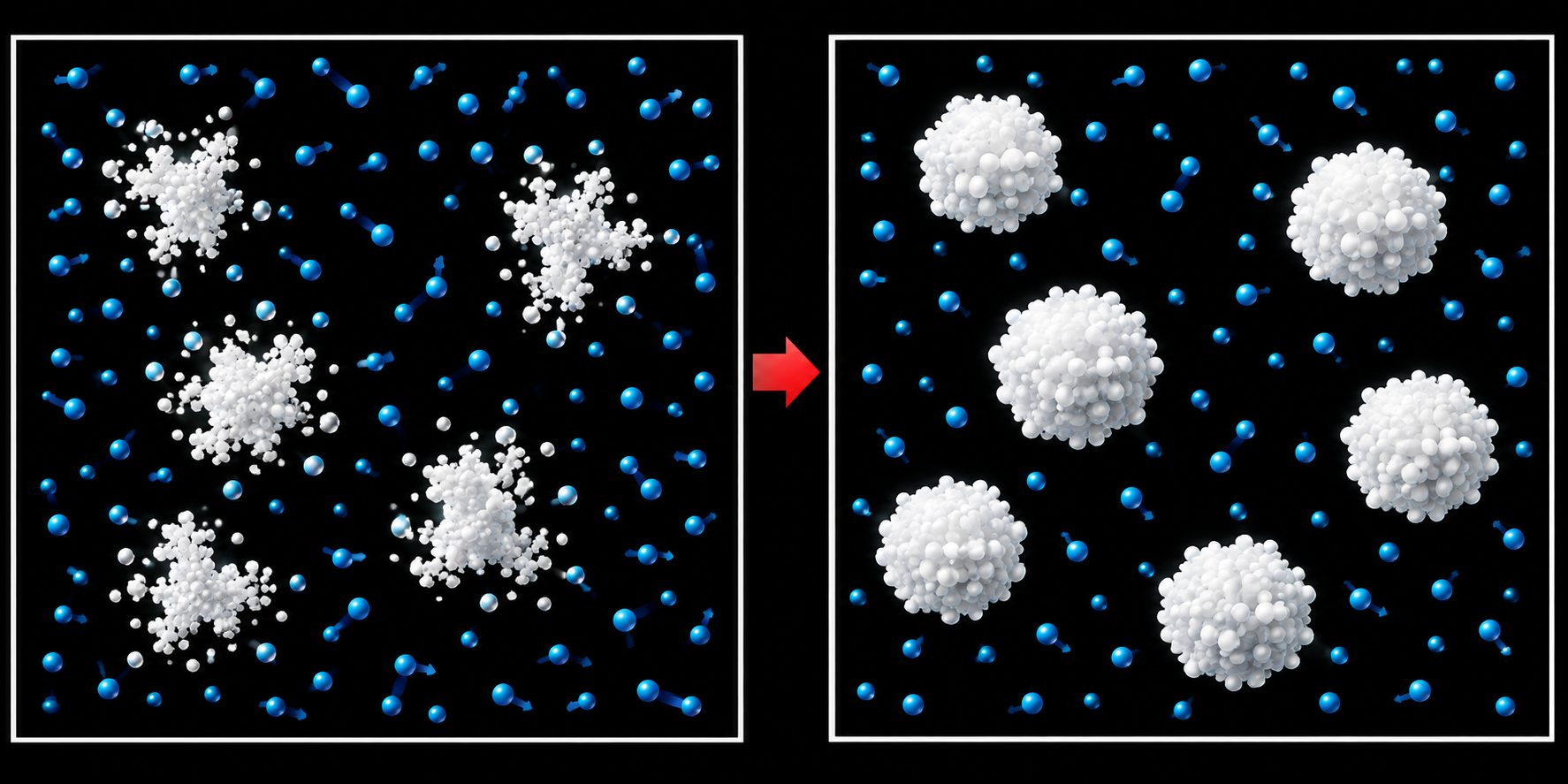
The vaporized silicon dioxide then enters a quenching region where the plasma is cooler, and the particles begin to aggregate, as shown in Fig. 4. The average particle diameter is around 14 nm for fumed silica grade 150, which has a specific surface area of approximately 150 ± 15 m²/g. The quality of the fumed silica has been independently tested by McGill University.
The vaporization step requires a lot of energy, but this is compensated for by the direct route it opens up for producing fumed silica. Flame hydrolysis, on the other hand, involves several chemical processing steps that together require a lot of energy compared to the plasma process, as shown in Fig. 1. The input material for flame hydrolysis is silicon tetrachloride, which is produced as a by-product of the silicon industry. Factories are often built close to silicon processing factories often in China to have ready supply of feedstock. In contrast, the plasma process uses quartz (silicon dioxide) directly, allowing factories to be located in regions with plentiful quartz resources and suitable electricity supplies, also no hazardous chlorine containing by-products are produced.
This is actually a new or different paradigm for producing inorganic compounds. This is somewhat analogous to making a journey from A to B, where a drone first expends energy to gain height, which then opens up a more direct route. The chemical steps are analogous to a car driving in a city, where a more indirect route has to be used to arrive at B, as shown in Fig. 5.

Around the world, chemical processes for making inorganic nanoparticles are very prevalent, and these are often difficult to scale up and turn into industrial processes. The fumed silica reactor is relatively simple and relies more on simple physical principles rather than complicated chemical pathways; and as a physicist, I am happy to celebrate this "victory" over chemistry, a subject which I grudgingly respect as I have always found it difficult.
The 1,000-tonne-per-year fumed silica reactor can be multiplied to increase output. This breakthrough in fumed silica production has not gone unnoticed in the global fumed silica community, and discussions between partners are ongoing. The details are hidden by NDAs, but for investors, it is useful to speculate about possible outcomes.
The Fumed Silica Plasma Reactor
The Path to Commercialisation
YouTube interviews of the CEO of HPQ Silicon Bernard Tourillon, are hard to interpret, as the negotiations and the usual corporate machinations are obscured by NDAs. However, it seems that in the first half of 2026 the companies were in negotiation with one partner for a 1,000-tonne reactor where the capex was to be provided by that partner. A recent update by PyroGenesis indicates that talks hit a speed bump (my paraphrasing) due to unreasonable IP demands by the partner who perceived the two companies to be desperate microcaps (again my paraphrasing), but then more companies joined the negotiations, which changed the dynamics in favor of HPQ Silicon Inc. and PyroGenesis.
This was followed by an announcement by Tourillon that more potential customers had joined the negotiations, including one customer that could require several production systems with capacities of 10,000 tonnes per year each, to replace a more expensive material with fumed silica. Let me spell this out: the dramatic reduction in the potential cost of fumed silica could open up new markets, create new products, or replace more expensive materials in existing products, thus expanding the total addressable market (TAM).
The negotiating table must now look rather crowded, and we can imagine it as a game of cards,
as illustrated in Fig. 6. We don't know the identities of all the players, but that doesn't matter.
We can assume they include established producers,
newcomers seeking to enter the fumed silica market, and HPQ Silicon and PyroGenesis.
The latter two hold some aces through their 50–50 distribution of royalties from their potentially disruptive plasma technology for producing fumed silica. However, they also hold some weaker cards,
given their relatively low market capitalizations of USD 46 million and USD 35 million, respectively.
Looking on are government officials who may be interested
in greener technologies and reshoring fumed silica production from China.

Established Producer The established producers would naturally be concerned about the economics of their factories. German and American companies have factories in China close to silicon manufacturing facilities that supply the input material. While China hosts roughly 40 percent of global fumed silica production, it controls 80 percent of global silicon metal production. With the legacy technology, fumed silica production is only possible near silicon metal production facilities due to the volatile nature of silicon tetrachloride. Legacy companies have a chance to open new factories in the West. Government officials in the West are well aware of their dependence on China for critical minerals, and plasma processing technology offers a way to reshore fumed silica production and contribute to their lofty green ambitions, since the plasma method uses considerably less energy than flame hydrolysis.
Potential New Factories In Europe, northern Sweden and Norway could be optimal locations for establishing new factories to take advantage of low electricity prices and the prevalence of silicon dioxide resources, including quartz and quartzite deposits mined by companies such as Elkem ASA (Oslo: ELK) in Norway. In North America, Quebec offers low electricity prices and readily available quartz resources. Table 1 shows the electricity prices for these regions and the estimated electricity cost in USD to produce one tonne of fumed silica, compared with more expensive regions such as the UK and parts of the United States. For reference, the table also contains an entry for China using the conventional flame hydrolysis process.
| Location | Production method | Electricity price (USD/kWh) | Electricity cost (USD/tonne) | Price basis |
|---|---|---|---|---|
| Northern Norway (NO4) | Plasma | $0.0098 | $98 | 2025 wholesale average |
| Northern Sweden (SE2) | Plasma | $0.0187 | $187 | 2025 wholesale average |
| Finland | Plasma | $0.0457 | $457 | 2025 wholesale average |
| Quebec, Canada (Montreal) | Plasma | $0.0480 | $480 | 2025 large-power customer tariff example |
| Texas, USA | Plasma | $0.0655 | $655 | 2025 industrial retail average |
| Germany | Plasma | $0.1009 | $1,009 | 2025 wholesale average |
| United Kingdom | Plasma | $0.1067 | $1,067 | 2025 wholesale average |
| California, USA | Plasma | $0.2162 | $2,162 | 2025 industrial retail average |
| China | Conventional flame hydrolysis | Varies by factory | ~$3,000 | Illustrative total manufacturing cost per tonne; inferred from Chinese market quotations, not independently verified factory accounts. |
Methodology: Plasma electricity expenditure assumes 10,000 kWh per tonne of fumed silica, based on the midpoint of HPQ Silicon's modeled 8–12 kWh/kg range. Electricity cost = electricity price multiplied by 10,000 kWh.
Important: These are indicative electricity expenditures and excludes other costs.
Sources: Energy-Charts, European wholesale prices ; UK wholesale electricity prices ; Hydro-Quebec, 2025 electricity price comparison ; US Energy Information Administration ; Bank of Finland, exchange rates ; HPQ Silicon, modeled energy consumption .
Potential New products Cheaper fumed silica produced in regions with low electricity prices and plentiful supplies of silica minerals, such as Quebec in Canada and northern Norway and Sweden in Europe, could open up possibilities for new products in which more expensive materials are replaced by fumed silica.
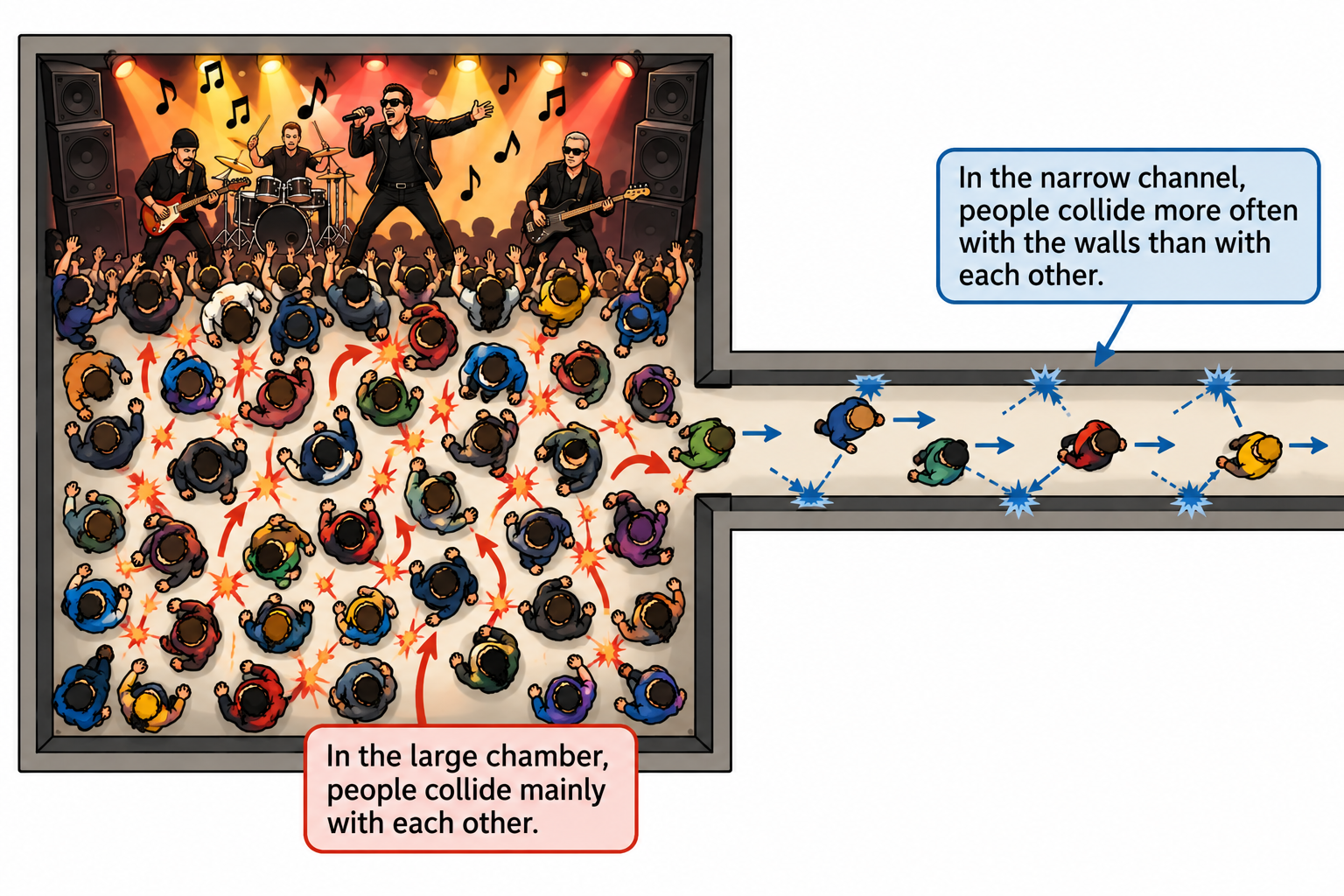
Fumed silica is a very good thermal insulator due to the Knudsen effect, shown in Fig. 7. Heat is transferred through air by the movement and collisions of air molecules. Molecules in hotter regions move faster on average than those in colder regions, and through collisions, energy is transferred until the temperature becomes uniform. Macroscopically, this is experienced as heat transfer. When air molecules enter the pores of fumed silica, where the pore dimensions are comparable to or smaller than the mean free path (MFP) of air molecules, the molecules collide more frequently with the pore walls than with each other, inhibiting heat transfer through the gas.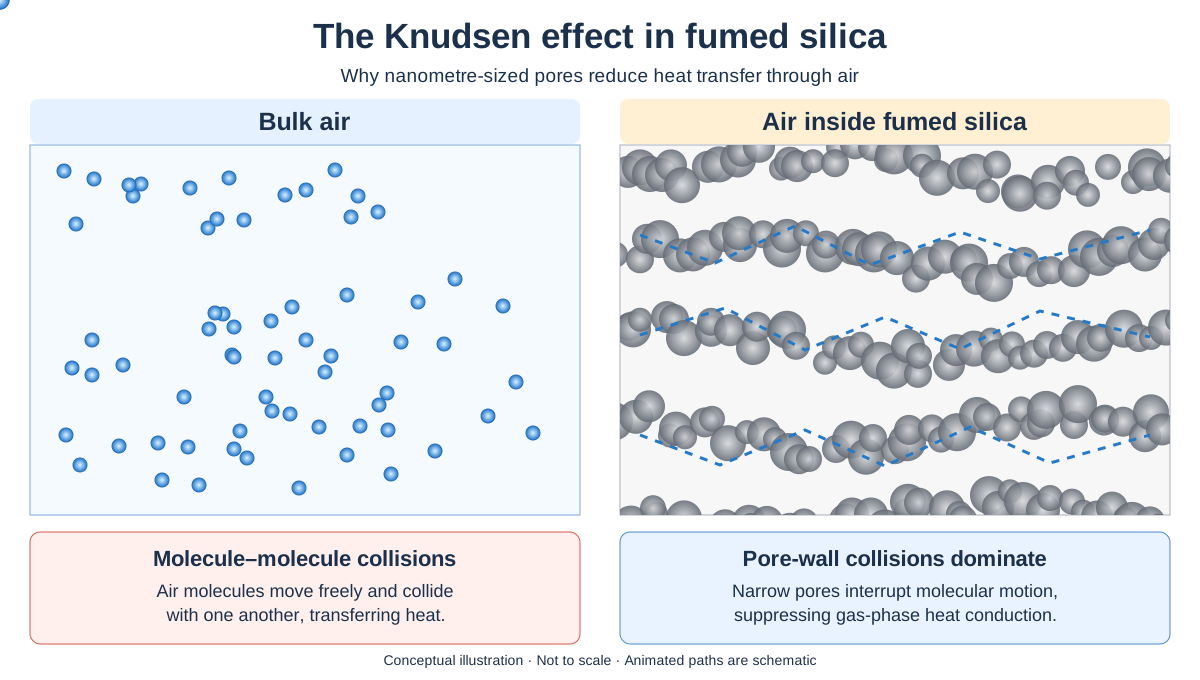
| Application | Current material | Fumed silica | VIP |
|---|---|---|---|
| Home insulation | Mineral wool: 10 cm | 5.7 cm | 1.1 cm |
| Winter footwear | Wool: 1 cm | 0.5 cm | 0.1 cm* |
| Refrigeration | Polyurethane foam: 5 cm | 4 cm | 0.8 cm |
Note: Thicknesses are calculated from representative thermal conductivities: mineral wool 0.035, wool 0.040, polyurethane foam 0.025, fumed silica 0.020, and VIP 0.004 W/(m·K). Actual performance depends on material formulation and installation. *The footwear VIP value is theoretical: conventional VIPs are generally unsuitable for repeated bending and compression.
Summary Discussions are ongoing, and no one really knows when a definitive agreement will be reached, but the way forward appears to be non-dilutive for shareholders, with the joint venture partner paying PyroGenesis for reactor engineering costs and both companies receiving equal shares of the royalties paid by the partner(s). The technology could be used to increase the production of fumed silica in the Western world for established applications such as paints, food products, and pharmaceuticals, as well as many new applications involving thermal insulation.
Disclaimer This article is intended to provide readers with an understanding of the scientific principles underlying the plasma production of fumed silica. The author is a physicist with experience in research projects involving carbon nanotubes , plaster formation, semiconductors , and quantum dots . The author holds shares in both companies discussed in this article but is not a financial advisor. Readers are encouraged to seek advice from a qualified financial advisor before making any investment decisions. Contact me: V Narayan Lonewolf-investing@proton.me